Characteristics of Long-Lived Tropopause Polar Vortices
Summary
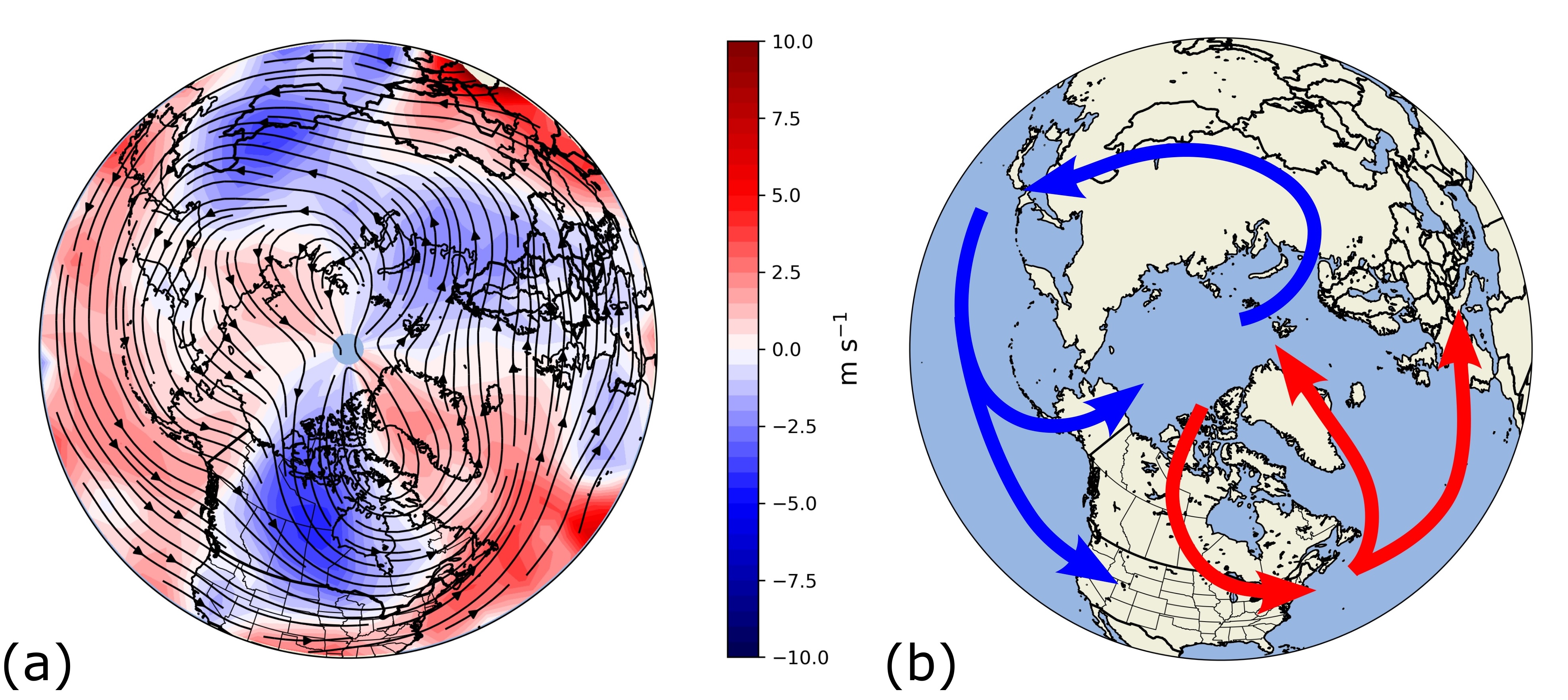
Tropopause polar vortices (TPVs) are coherent circulations, common throughout the polar regions, that are centered on the tropopause but extend throughout the upper troposphere and lower stratosphere (UTLS) region. Spatially, TPVs fall into the mesoscale, with radii generally on the order of hundreds of kilometers. Temporally, though, TPVs are distinctly synoptic to sub-seasonal, often persisting for weeks or even months. During these long lifetimes, TPVs can interact with a variety of other atmospheric phenomena, including surface cyclones and jet streams. Moreover, long-lived TPVs commonly enter the midlatitudes, where they have been linked with spurring severe weather events (see the TPVs and Severe Weather page) and cold air outbreaks.
To better understand how some TPVs persist for such long periods of time, I conducted a climatological analysis of long-lived (greater than two weeks) TPVs using the ERA-Interim dataset. These TPVs most often occurred in the summer, were relatively strong, and tended to reside for most of their lifetime at very high latitudes, far away from high-shear environments. Most of the time, these long-track TPVs formed by splitting off from an existing TPV, but I also documented numerous cases in which poleward Rossby wave breaking events formed new TPVs. Towards the end of their lifetime, many of these TPVs entered the midlatitudes through one of two major pathways, a useful pattern for forecasting TPV-impacted weather events.
Publications
Bray, M. T. and S. M. Cavallo, 2022: Characteristics of Long Track Tropopause Polar Vortices. Wea. Climate Dyn., 3, 251–278, https://doi.org/10.5194/wcd-3-251-2022.
Conference Presentations
Bray, M. T. and S. M. Cavallo, 2021: “Characteristics of Long Track Tropopause Polar Vortices.” 16th Conference on Polar Meteorology and Oceanography, Virtual, American Meteorological Society. Oral Presentation.