Interactions between Tropopause Polar Vortices and Arctic Cyclones
Summary
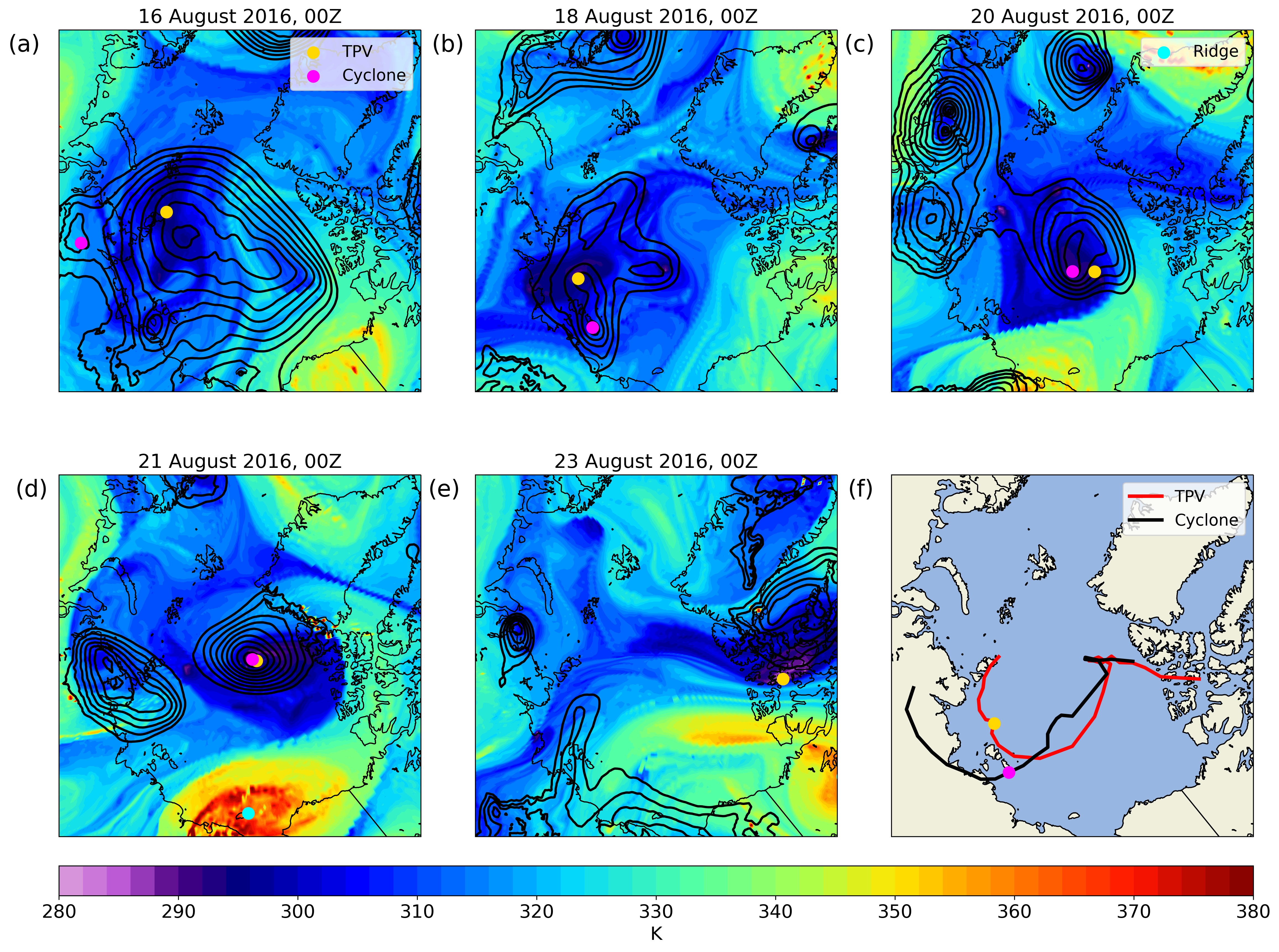
Arctic cyclones (ACs) are one of the main synoptic-scale features of the Arctic atmosphere, driving heat and moisture transport into the region and impacting the underlying sea ice via dynamic and thermodynamic forcing. Compared to midlatitude cyclones, ACs are unusually long-lived, and these systems tend to be larger than the Rossby radius would suggest at high latitudes. ACs are known to interact regularly with tropopause polar vortices (TPVs), which can help to strengthen the surface systems and often remain linked to ACs for days after the cyclone has reached its maximum intensity. This is especially true for summer AC cases, although ACs in all seasons have been found to interact with TPVs with some frequency.
Across several projects, including my M.S. thesis and ongoing dissertation work, I have investigated AC-TPV linkages in greater detail. In particular, I am interested in whether TPV interactions can help to answer the open questions of AC lifetime and size and in how TPV characteristics like strength, shape, and position can be used to predict AC development. Using an observing system simulation experiment (OSSE), in which simulated observations can be freely generated and assimilated into a model, a clear connection emerged between increased upper air observations around a TPV at the start of a forecast and improved Arctic cyclone representation several days later. Observations that improved the model's representation of the TPV's mesoscale structure and position relative to the AC were especially impactful. Currently, I'm looking into how TPVs and ACs are represented in the CESM2 earth system model. Preliminary results suggest that CESM2's relatively low spatial resolution causes AC-TPV linkages to be systematically under-represented.
Publications
Bray, M. T. and S. M. Cavallo, 2024: Investigating Arctic Cyclone–Tropopause Polar Vortex Interactions with Idealized Observing System Simulation Experiments. Mon. Wea. Rev., 152, 1445–1467, https://doi.org/10.1175/MWR-D-23-0215.1.
Rivière, G. and Coauthors (including M. T. Bray), 2024: The THINICE Field Campaign: Interactions between Arctic Cyclones, Tropopause Polar Vortices, Clouds, and Sea Ice in Summer. Bull. Amer. Meteor. Soc., 105, E2330–E2354, https://doi.org/10.1175/BAMS-D-23-0143.1.
Conference Presentations
Bray, M. T. and S. M. Cavallo, 2025: “Arctic Cyclones, Tropopause Polar Vortices, and Sea Ice in the Community Earth System Model v2.” American Meteorological Society18th Conference on Polar Meteorology and Oceanography, Denver, CO. Oral Presentation.
Bray, M. T. and S. M. Cavallo, 2024: “Arctic Cyclones and Tropopause Polar Vortex Linkages in the Community Earth System Model v2.” 20th Cyclone Workshop, Saint-Sauveur, QC, Canada. Oral Presentation.
Bray, M. T. and S. M. Cavallo, 2023: “Investigating Arctic Cyclone-Tropopause Polar Vortex Interactions with Observing System Simulation Experiments.” American Meteorological Society 32nd Conference on Weather Analysis and Forecasting (WAF)/28th Conference on Numerical Weather Prediction (NWP)/20th Conference on Mesoscale Processes, Madison, WI. Oral Presentation.
Bray, M. T. and S. M. Cavallo, 2022: “Investigating Interactions between Arctic Cyclones and Tropopause Polar Vortices through Observing System Simulation Experiments.” American Meteorological Society 17th Conference on Polar Meteorology and Oceanography, Madison, WI. Oral Presentation.